Welcome to Wyoming. We decided to explore a different section of the state. We were in the southeastern part of the state and would be heading further southwest from here towards Utah. You can see Wyoming has a lot of wide-open prairies. The Pony Express Riders once crossed through the area carrying the west's first mail. It was called the Bozeman Trail which was abandoned over 140 years ago in 1867.
I am always amazed when I see these rock formations along the route. They are absolutely fascinating and one can't help but wonder how they were formed.
More rock formations.
This is the town of Lost Springs, WY. Population 1; Elevation: 4,996 ft. Wyoming has another town with the population of 1, it's called Buford and is east of here (I believe). Lost Springs is the smallest incorporated town in WY. with an elected mayor and is located on Hwy. 20 on the eastern edge of Converse County. It has an antique store, a park and a great photo op next to the "Population 1" sign.
Here in Lost Springs you can view coal trains, some which are 135 cars long which are heading east on the Union Pacific Railroad's triple tracks.
This just happens to be one of the track crossings in Long Springs. As you can see, the man in the picture decided to get out of his car (it was a really hot and humid day) and wait for the train to pass.
While in the area we saw many trains like the one above loaded down with coal and other objects going down the tracks. Most of the trains have two engines pulling the cars and two engines pushing from the rear.
Here the cars are really loaded down with coal.
More of the same train as we traveled along beside the tracks on the highway.
Really pretty countryside don't you think?
Hello! I'm a Jackalope. I'm a native of Wyoming and can only be found in Converse County. Douglas, WY has been known as the "Home of the Jackalope" ever since Douglas native Doug Herrick created the first one in 1939. There are many urban legends all over the world about this little fellow. The Governor of Wyoming proclaimed Douglas to be the official "Home of the Jackalope" back in 1985. There are several statutes erected to the little fellow.
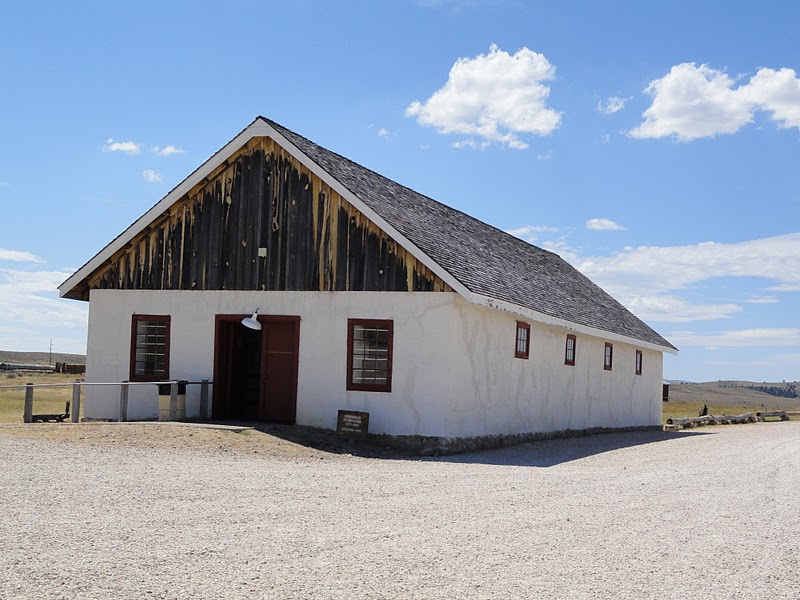
Here he is outside the Douglas Railroad Interpretive Center which also doubles as the Visitor's Center. This building was the passenger depot of the Fremont, Elkhorn & Missouri Valley Railroad and has been restored by the City of Douglas.
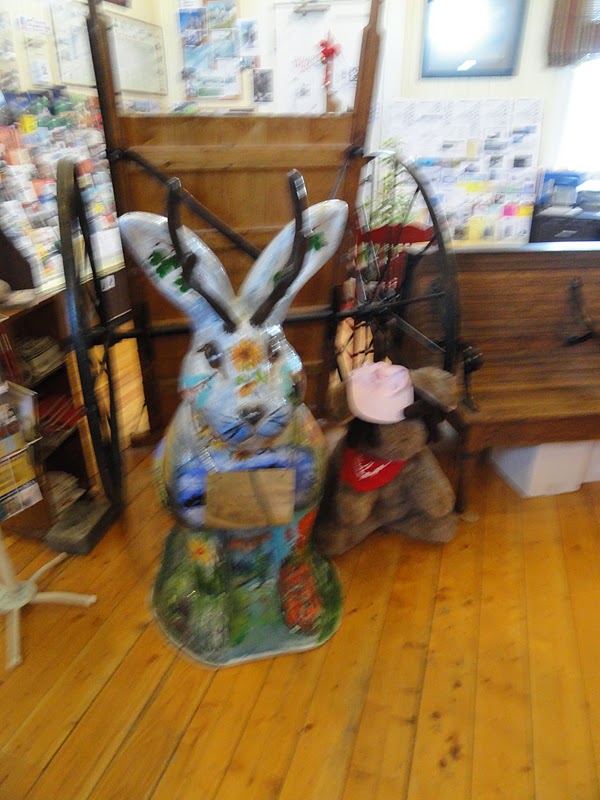
Inside the Visitor's Center is another Jackalope which was created by some of the local senior citizens.
Another little fellow behind bars.
OOPS, somehow he got out of his cage. He's a crafty little guy.
The depot has several of the train cars on display, several of which are open for exploration.
This is called the Day Coach (Coach #1886 which was first placed in service in 1884). The coach could hold a total of about 72 adults, two per seat. It was called a day coach because with the bands of broad windows, ventilating skylights and fixed, straight seat backs, it was intended to accommodate passengers on trips of only a single day's duration.
The Caboose dates from the 1830's which train workers were being housed in roughshod shanties built atop flatcars. This arrangement led to the design of what was known as: the "crummy", the "doghouse", the "bone-breaker", the Snake wagon" and finally the "caboose" (which term may derive from the Dutch word for a ship's galley, kabuis). Today, cabooses are obsolete: automatic air brakes have eliminated the manual version, automatic signal lights have replaced flagging, etc.
The Locomotive. This is CB&Q #5633 and is one of the last steam locomotives built. This engine could cruise at 100 miles per hour, while pulling thousands of tons. When it was retired in 1962, #5633 had rolled more than one million miles.
This is known as the Fairmont Motor Car which was used to inspect track and transport workers (larger versions could accommodate 12 people or more). This was a one-seater, the smallest available model. Today, these retired track cars are prized as collector's items and recreational vehicles.
The Dining Car (CB&Q #196). This car was nicknamed the "Silver Salver". It originally ran the rails between Chicago and Minneapolis. Such cars were at first used only on trains catering to the well-to-do, competition eventually led to their inclusion on passenger trains of every type. Diners like these were never profitable for the railroads, they were the heaviest of all passenger vehicles and very expensive to manufacture, maintain and staff. Some of these cars at retirement were often purchased from railroads and set up as stationary, roadside diners, similar to those commonly found in various cities throughout the 1930s and 1940s.

The Baggage Car UP#1897. What can you say about a baggage car. From early on, baggage cars were the frequent targets of train robbers, who knew where the goods were kept. Today the interior is essentially an open box; however, originally, #1897 was designed as a mail car--and, as such, included a complex assortment of apparatus for the manual sorting of the mail while in-transit.